Introduction
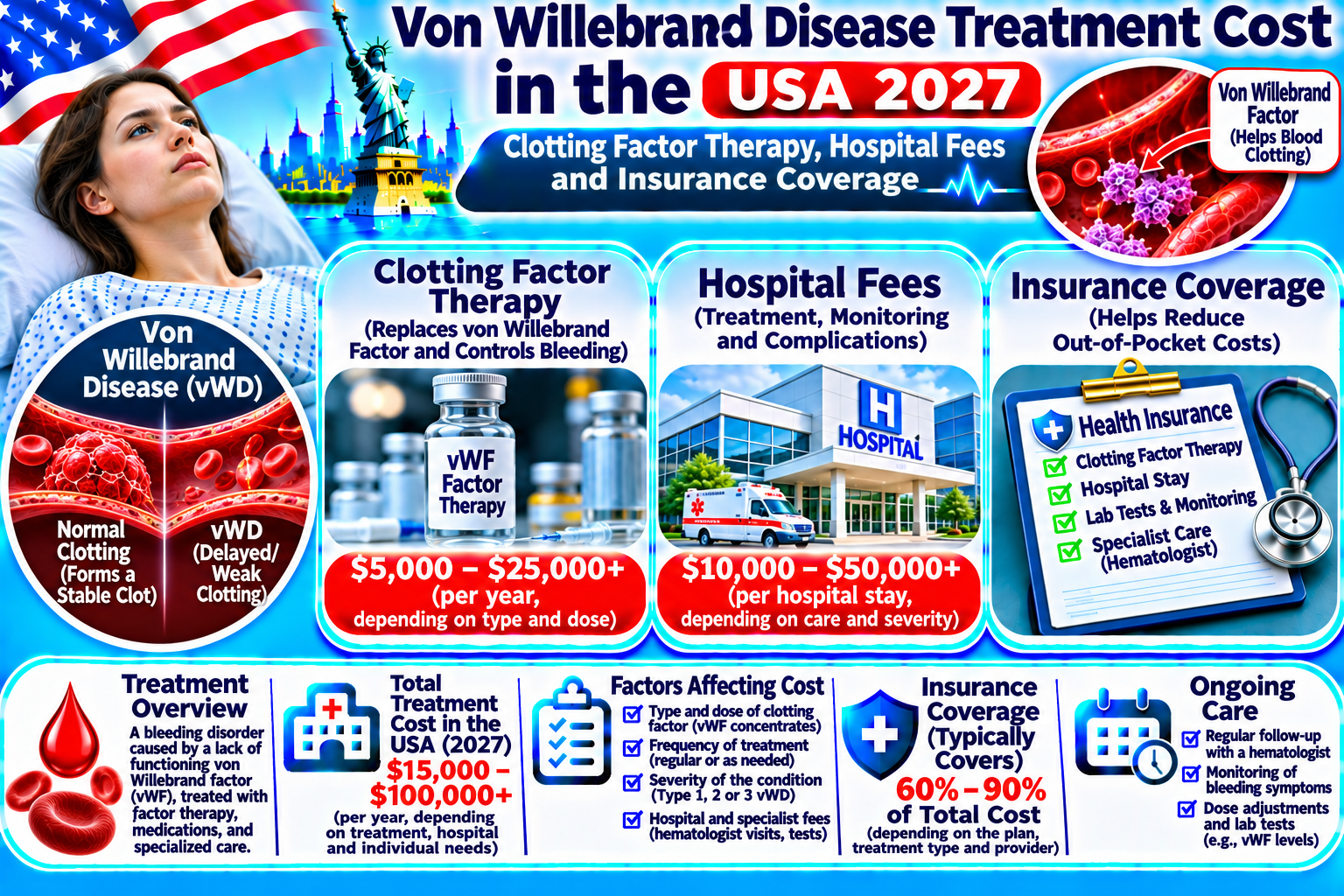
Von Willebrand disease is a bleeding disorder that affects the blood’s ability to form stable clots. People with this condition may experience frequent nosebleeds, heavy menstrual bleeding, prolonged bleeding after surgery, or excessive bleeding following an injury. Treatment may involve medications, von Willebrand factor replacement therapy, emergency hospital care, and regular monitoring by a hematologist.

Understanding von Willebrand disease treatment costs in the USA in 2027 is important for patients and families comparing clotting factor therapy prices, specialist consultations, diagnostic testing, hospital expenses, and health insurance coverage.
Costs vary significantly depending on the disease type, bleeding severity, treatment frequency, medication selection, and insurance benefits. Some patients require treatment only before procedures or during bleeding episodes, while others need repeated factor replacement therapy.
This guide examines estimated American von Willebrand disease treatment expenses for 2027, including diagnosis, medications, factor concentrates, hospitalization, insurance coverage, and long-term financial planning.
What Is Von Willebrand Disease?
Von Willebrand disease, commonly abbreviated as VWD, is a bleeding disorder involving von Willebrand factor, a protein that helps platelets attach to damaged blood vessels and supports the stability of clotting factor VIII.
When von Willebrand factor is deficient or does not function properly, the body may have difficulty controlling bleeding.
Most cases are inherited, although an acquired form can develop in association with certain medical conditions.
The severity varies widely. Many people experience relatively mild symptoms, while others develop serious bleeding complications that require specialized treatment.
Types of Von Willebrand Disease
Type 1 Von Willebrand Disease
Type 1 is the most common form and involves a partial quantitative deficiency of von Willebrand factor.
Symptoms are often mild to moderate, although bleeding severity varies between individuals.
Type 2 Von Willebrand Disease
Type 2 involves von Willebrand factor that does not function normally. It includes several subtypes, such as 2A, 2B, 2M, and 2N.
These subtypes can respond differently to treatment, making accurate diagnosis important.
Type 3 Von Willebrand Disease
Type 3 is a rare and severe form characterized by extremely low or undetectable von Willebrand factor levels.
Patients may experience serious bleeding episodes and often require factor replacement therapy.
Common Symptoms of Von Willebrand Disease
- Frequent or prolonged nosebleeds.
- Easy bruising.
- Heavy or prolonged menstrual bleeding.
- Excessive bleeding after dental procedures.
- Prolonged bleeding following injuries.
- Unexpected bleeding after surgery.
- Bleeding into joints or muscles in severe cases.
- Iron-deficiency anemia caused by recurrent blood loss.
Symptoms may resemble those of other bleeding disorders. Persistent or severe bleeding requires professional medical evaluation.
How Is Von Willebrand Disease Diagnosed?
Complete Blood Count
A complete blood count helps assess anemia and platelet levels, although results may be normal in many patients with VWD.
Von Willebrand Factor Antigen Test
This test measures the amount of von Willebrand factor circulating in the bloodstream.
Von Willebrand Factor Activity Testing
Activity tests evaluate how effectively von Willebrand factor performs its clotting-related functions.
Factor VIII Activity Test
Because von Willebrand factor helps stabilize factor VIII, clinicians may measure factor VIII activity during evaluation.
Additional Specialized Testing
Multimer analysis and other specialized assays may help identify specific VWD subtypes.
Repeated testing is sometimes necessary because von Willebrand factor levels can change with stress, illness, pregnancy, and other physiological conditions.
Von Willebrand Disease Treatment Options
Desmopressin
Desmopressin, commonly called DDAVP, stimulates the release of stored von Willebrand factor and factor VIII.
It can be effective for selected patients, particularly some individuals with type 1 VWD.
However, it is not appropriate for every subtype or clinical situation. Patients may require a supervised response test before treatment.
Von Willebrand Factor Replacement Therapy
Factor replacement therapy provides von Willebrand factor through intravenous infusion.
Products may contain both von Willebrand factor and factor VIII, or recombinant von Willebrand factor without added factor VIII.
Examples include Humate-P, Wilate, and Vonvendi, although product selection depends on the clinical situation and approved indications.
Tranexamic Acid
Tranexamic acid is an antifibrinolytic medication that helps prevent formed blood clots from breaking down too quickly.
It may be used for certain dental procedures, mucosal bleeding, or heavy menstrual bleeding.
Hormonal Treatment
Selected patients with heavy menstrual bleeding may benefit from hormonal therapies as part of an individualized treatment plan.
Iron Replacement
Patients with iron-deficiency anemia caused by recurrent blood loss may require oral or intravenous iron supplementation.
Emergency Bleeding Treatment
Severe bleeding may require hospital admission, factor replacement, blood transfusions, and treatment of the underlying bleeding source.
Von Willebrand Disease Treatment Cost in the USA in 2027
American VWD treatment expenses vary according to disease severity, medication requirements, infusion frequency, and hospital resources.
Specialty clotting factor concentrates can be particularly expensive, especially when repeated doses are necessary.
The following figures are illustrative 2027 budgeting estimates, not verified national averages, guaranteed hospital quotations, or actual patient out-of-pocket payments.
Estimated USA Cost Breakdown
| Treatment or Service | Estimated Cost (USD) |
|---|---|
| Hematologist Consultation | $200–$700+ |
| Initial Blood and Coagulation Tests | $200–$1,500+ |
| Specialized VWD Subtype Testing | $500–$2,500+ |
| Desmopressin Treatment Episode | $100–$1,000+ |
| Oral Tranexamic Acid Course | $30–$300+ |
| VWF Concentrate Infusion Episode | $2,000–$15,000+ depending on dose and product |
| Repeated Factor Replacement Treatment | $10,000–$60,000+ per month in high-use scenarios |
| Outpatient Infusion Administration | $200–$1,500+ excluding medication |
| Emergency Department Visit | $1,000–$5,000+ |
| Hospital Admission for Bleeding | $8,000–$40,000+ |
| Complex Bleeding Hospitalization | $30,000–$100,000+ |
| Hematology Follow-Up Appointment | $150–$500+ |
Important: These are hypothetical planning ranges. Factor replacement costs depend heavily on patient weight, required units, product pricing, and treatment duration. Hospital episode estimates may already include medication, infusion, laboratory, and physician charges.
USA Von Willebrand Disease Cost Comparison
Because this article focuses on the United States, the following table compares different American treatment scenarios rather than international countries.
| USA Treatment Scenario | Illustrative Budget |
|---|---|
| Mild VWD With Occasional Treatment, Annual | $500–$5,000+ |
| Diagnostic Evaluation and Medication | $1,000–$6,000+ |
| Factor Replacement for a Procedure | $5,000–$30,000+ |
| Severe VWD With Repeated Factor Therapy, Annual | $50,000–$250,000+ |
| Major Bleeding Episode With Hospitalization | $20,000–$100,000+ |
These scenarios are not standardized treatment packages. Actual costs may be substantially higher or lower depending on medical needs and insurance arrangements.
Clotting Factor Therapy Costs
Von Willebrand factor replacement therapy can be the largest expense for patients with severe VWD. These medications replace the missing or poorly functioning clotting protein and help prevent or control bleeding.
The required dose depends on body weight, disease severity, treatment goals, and laboratory results. A patient receiving treatment before major surgery may require several infusions over multiple days.
Patients with frequent serious bleeding may benefit from regular preventive infusions, called prophylaxis. This approach can reduce bleeding episodes but may generate substantial annual medication expenses.
A 2025 US economic analysis estimated annual prophylactic factor costs of approximately $286,000 for a modeled adult with type 3 VWD receiving a plasma-derived VWF/FVIII concentrate. This was a research-model estimate, not a universal treatment price or a confirmed 2027 cost.
Desmopressin Treatment Expenses
Desmopressin may provide a lower-cost treatment option for patients who respond appropriately.
Before relying on desmopressin, hematologists may perform a supervised treatment trial to evaluate changes in clotting factor levels.
Desmopressin is generally ineffective for type 3 VWD and is unsuitable for some type 2 subtypes, particularly type 2B.
It can also cause fluid retention and low blood sodium levels. Patients must follow medical instructions about fluid intake and monitoring.
Hospital Fees for Severe Bleeding
Hospitalization may be required when patients experience major bleeding, significant anemia, or complications following surgery.
Common hospital expenses include:
- Emergency department evaluation.
- Hematologist consultation.
- Clotting factor replacement medication.
- Intravenous treatment administration.
- Blood tests and coagulation monitoring.
- Blood transfusions when necessary.
- Diagnostic imaging or procedures.
- Inpatient nursing and observation.
- Intensive care for life-threatening bleeding.
Hospital bills increase when bleeding is difficult to control or repeated factor infusions are required.
Surgery and Dental Procedure Costs
Patients with VWD may need additional medical planning before surgery, dental extraction, childbirth, or invasive diagnostic procedures.
The hematologist may recommend desmopressin, factor replacement, tranexamic acid, or a combination of treatments.
Expenses depend on the procedure’s bleeding risk, medication requirements, and monitoring needs.
Major operations may require repeated factor level testing and several days of clotting factor replacement.
Von Willebrand Disease Treatment With Health Insurance
Many comprehensive American health insurance plans cover medically necessary VWD treatment, including eligible diagnostic testing, prescription medications, clotting factor concentrates, and hospital services.
However, coverage depends on the patient’s policy, treatment requirements, provider network, and authorization rules.
Important insurance considerations include:
- Annual deductible and out-of-pocket maximum.
- Hematologist and hospital network participation.
- Prescription and specialty pharmacy benefits.
- Prior authorization for factor concentrates.
- Coverage for home infusion supplies.
- Emergency hospitalization benefits.
- Laboratory testing and monitoring coverage.
- Medication copayments and coinsurance.
Insurance approval does not necessarily eliminate personal expenses. Patients should confirm their expected out-of-pocket responsibility before scheduled treatment.
Medicare Coverage for Von Willebrand Disease
Original Medicare may cover medically necessary VWD treatment for eligible beneficiaries when applicable coverage requirements are satisfied.
Medicare Part A generally applies to qualifying inpatient hospital care, while Part B covers eligible physician services and certain outpatient treatments.
Medicare Part D may cover qualifying outpatient prescription medications.
Coverage for clotting factor products and home infusion services depends on the patient’s clinical circumstances and applicable Medicare benefit rules.
Medicaid and Financial Assistance
Medicaid may cover medically necessary VWD treatment for eligible individuals, depending on state-specific benefits and requirements.
Some patients may qualify for support through hemophilia treatment centers, hospital financial assistance programs, or medication assistance resources.
Eligibility varies, so patients should verify available benefits with their healthcare providers and insurers.
Von Willebrand Disease Treatment Without Insurance
Uninsured patients may face substantial expenses for clotting factor concentrates, diagnostic testing, emergency visits, and hospitalization.
Before planned treatment, patients should request written estimates from hospitals and specialty pharmacies.
They should also ask whether medication, infusion administration, laboratory testing, and specialist fees are included.
Factors Influencing Von Willebrand Disease Treatment Prices
1. Disease Type and Severity
Patients with mild type 1 VWD may require occasional treatment, while severe type 3 disease can involve repeated factor replacement.
2. Clotting Factor Product
Plasma-derived and recombinant VWF concentrates have different prices, dosing requirements, and administration considerations.
3. Treatment Frequency
Occasional treatment generally costs less than regular prophylactic infusions, although preventive treatment may reduce serious bleeding complications.
4. Hospital and Specialist Fees
Emergency care, hospitalization, hematologist consultations, and laboratory monitoring contribute to overall medical expenses.
5. Insurance Coverage
Deductibles, negotiated rates, provider networks, and prior authorization requirements influence patient financial responsibility.
6. Geographic Location
Healthcare prices vary across American states and cities because of regional operating expenses and insurance arrangements.
7. Complications and Additional Procedures
Major bleeding, anemia, surgical complications, and repeated hospital visits can substantially increase treatment expenses.
Long-Term Monitoring and Follow-Up Costs
Some patients require periodic hematology appointments and laboratory testing to assess bleeding symptoms and treatment effectiveness.
Patients receiving regular factor replacement may need additional monitoring to guide dosing and prevent complications.
Individuals experiencing heavy menstrual bleeding or recurrent blood loss may require iron testing and anemia treatment.
Long-term planning should also account for transportation, time away from work, and access to specialized bleeding disorder centers.
How to Reduce Von Willebrand Disease Treatment Costs
- Verify insurance benefits before scheduled treatment.
- Request complete written hospital estimates.
- Confirm hematologists and infusion centers are in-network.
- Ask whether desmopressin is medically appropriate.
- Review specialty pharmacy coverage.
- Explore manufacturer and nonprofit assistance programs.
- Discuss Medicare and Medicaid eligibility.
- Work with a bleeding disorder treatment center.
Patients should never stop prescribed treatment or change clotting factor doses solely because of cost without consulting their hematologist.
Frequently Asked Questions
How much does von Willebrand disease treatment cost in the USA in 2027?
Illustrative annual expenses may range from several hundred dollars for mild disease to hundreds of thousands of dollars for patients requiring regular clotting factor prophylaxis.
How much does clotting factor therapy cost?
Individual VWF concentrate infusion episodes may cost thousands of dollars. Expenses depend on product selection, body weight, dose, and treatment frequency.
Does insurance cover von Willebrand disease?
Many comprehensive insurance plans cover medically necessary VWD treatment, subject to policy requirements and patient cost-sharing.
Is desmopressin effective for every patient?
No. Desmopressin is appropriate only for selected patients and is generally unsuitable for type 3 VWD and certain type 2 subtypes.
Can von Willebrand disease be cured?
Inherited VWD generally has no established cure, but appropriate treatment can help control bleeding and reduce complications.
Do all patients require regular factor infusions?
No. Many patients need treatment only during bleeding episodes or before procedures. Regular prophylaxis is considered for selected patients with severe or frequent bleeding.
Conclusion
Von Willebrand disease treatment costs in the USA in 2027 depend on clotting factor therapy, medication selection, hospital fees, bleeding severity, and insurance coverage.
Patients should compare complete treatment estimates, verify specialty medication benefits, and consult experienced hematologists before making medical decisions.
Accurate diagnosis, individualized treatment, consistent monitoring, and careful financial planning can help patients manage the long-term expenses associated with this bleeding disorder.
Medical Disclaimer: This article provides general educational and financial planning information only. It does not replace professional medical advice, diagnosis, or treatment. All 2027 cost ranges are illustrative estimates and should be verified directly with hospitals, hematologists, pharmacies, and insurance companies.
